
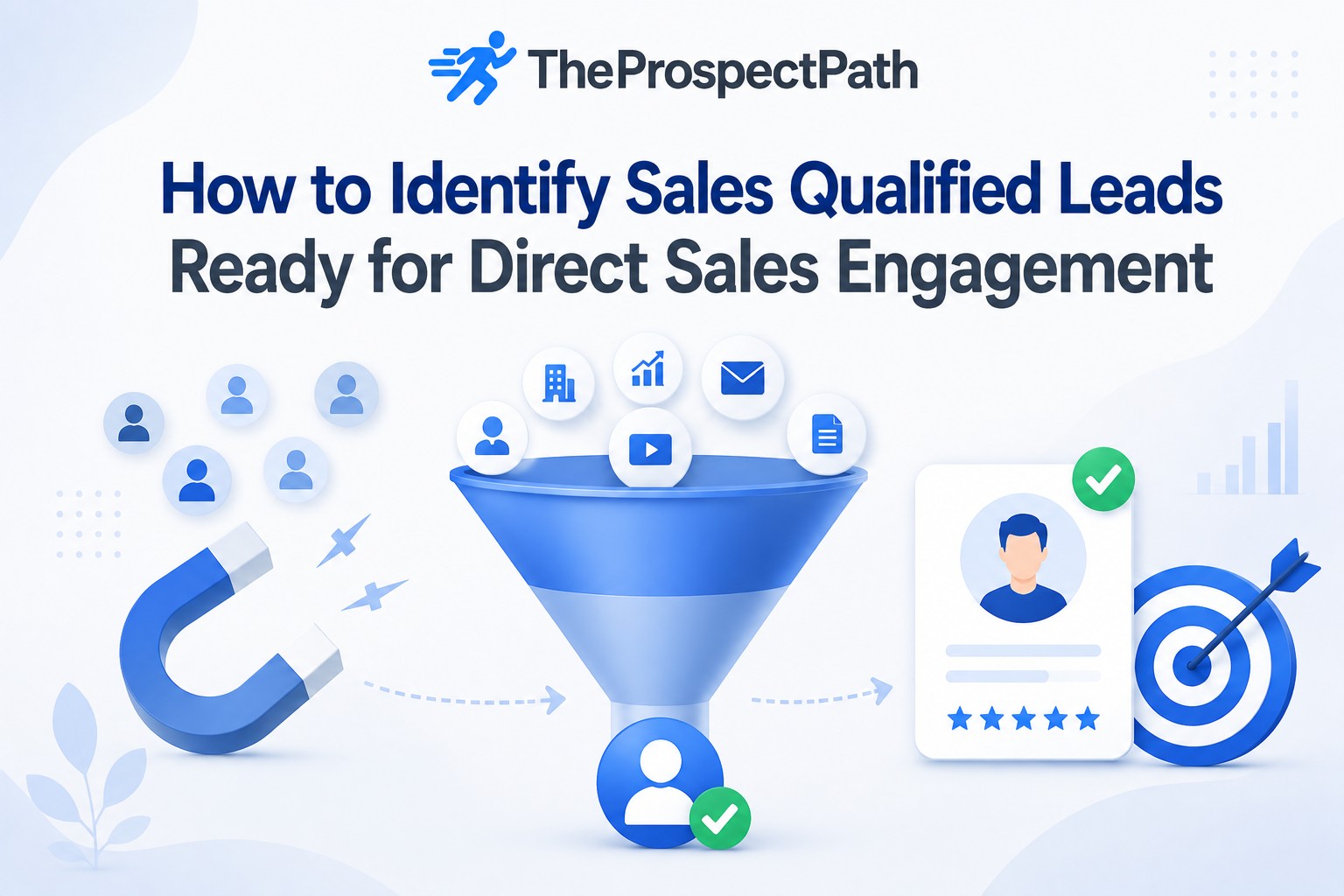
Generating leads is only the first step in building a successful B2B sales pipeline. The real challenge is identifying which prospects are ready to move beyond marketing interactions and engage directly with a sales representative. This is where Sales Qualified Leads (SQLs) become critical.
An SQL is a prospect who has demonstrated sufficient interest, business need, and purchasing potential to warrant direct sales engagement. Unlike a general lead or even a Marketing Qualified Lead (MQL), an SQL has typically progressed further through the buying journey and meets predefined criteria established by marketing and sales teams.
Identifying SQLs accurately helps businesses focus sales resources on prospects who are more likely to become opportunities and customers.
What Is a Sales Qualified Lead?
A Sales Qualified Lead is a prospect who has been evaluated against specific qualification criteria and determined to be ready for direct interaction with the sales team.
The exact definition varies between organizations, but SQLs commonly demonstrate several characteristics:
- A clearly identified business need
- Genuine interest in a potential solution
- Appropriate decision-making authority or access to decision-makers
- A realistic purchasing timeline
- Potential budget or willingness to invest
- Engagement with sales or marketing outreach
The objective is not to declare every engaged prospect an SQL. Instead, sales qualification should determine whether there is a realistic opportunity for a productive sales conversation.
SQL vs. MQL: What’s the Difference?
Understanding the difference between an MQL and an SQL is essential for effective lead qualification.
A Marketing Qualified Lead (MQL) has demonstrated enough engagement to indicate potential interest. For example, an MQL may download a whitepaper, attend a webinar, repeatedly visit a website, or engage with email campaigns.
An SQL, however, has progressed further. The prospect may have confirmed a business challenge, expressed interest in a specific solution, discussed purchasing requirements, or agreed to a conversation with sales.
In simple terms, an MQL shows marketing readiness, while an SQL demonstrates stronger sales readiness.
Key Signals That Indicate Sales Readiness
Identifying SQLs requires looking beyond individual actions and evaluating multiple buying signals together.
1. A Clearly Defined Business Need
One of the strongest indicators of an SQL is a specific and recognized business problem.
For example, a prospect may explain that its current lead generation process is producing poor-quality opportunities or that its sales team needs additional support reaching decision-makers.
A clearly defined problem creates a foundation for a meaningful sales conversation because the prospect understands why a solution may be necessary.
2. Active Interest in a Solution
Prospects who actively request information about products or services often demonstrate stronger sales intent.
Signals may include:
- Requesting a product demonstration
- Asking about pricing
- Requesting a proposal
- Seeking technical information
- Asking about implementation
- Requesting a consultation
These actions suggest that the prospect is moving from general research toward evaluating potential solutions.
3. Decision-Making Authority
A prospect may have a genuine business need but lack the authority to purchase.
SQL qualification should therefore determine whether the contact is a decision-maker, budget holder, key stakeholder, or someone who can influence the purchasing process.
When the contact is not the final decision-maker, sales teams should understand who else needs to be involved and whether the prospect can facilitate an introduction.
4. Budget Readiness
Budget is another important qualification factor.
An SQL does not necessarily need to provide an exact budget figure, but there should be reasonable evidence that the organization can fund the proposed solution or is willing to explore the investment required.
Understanding whether funding is already allocated, requires approval, or will become available during a future budget cycle helps sales teams determine how aggressively to pursue the opportunity.
5. A Defined Purchasing Timeline
Timing can distinguish a sales opportunity from a long-term prospect.
A prospect planning to implement a solution within the next few months is generally more sales-ready than a company that is simply researching potential options with no defined timeframe.
Useful qualification questions can explore whether the organization has a target implementation date, upcoming project, contract renewal, budget cycle, or internal deadline.
6. Positive Response to Direct Outreach
Direct engagement is one of the clearest indicators of sales readiness.
A prospect who responds positively to an email, agrees to a sales conversation, discusses business challenges during a telemarketing call, or requests a follow-up meeting has demonstrated a higher level of engagement than someone who only consumes marketing content.
Human conversations can also reveal information that digital engagement cannot provide.
Use Lead Scoring to Prioritize SQLs
A structured lead scoring system can help businesses evaluate prospects consistently.
Different actions and qualification characteristics can receive different scores. For example, downloading a general industry report may indicate early interest, while requesting a proposal or agreeing to a sales meeting may indicate significantly stronger intent.
Lead scoring can incorporate factors such as:
- Job role and seniority
- Company characteristics
- Industry relevance
- Website engagement
- Email engagement
- Content consumption
- Webinar participation
- Business need
- Budget
- Authority
- Timeline
- Direct sales engagement
When a prospect reaches a predefined threshold, the lead can be reviewed for SQL status.
Marketing and Sales Must Agree on SQL Criteria
One of the biggest challenges in B2B lead generation occurs when marketing and sales teams have different definitions of a qualified lead.
Marketing may consider a prospect qualified because of high engagement, while sales may reject the lead because there is no confirmed business need or purchasing timeline.
Creating a shared SQL definition solves this problem. Both teams should agree on the characteristics a prospect must demonstrate before being passed to sales.
Regular feedback is also important. Sales teams can provide information about which leads converted into opportunities, allowing marketing teams to refine targeting and qualification criteria.
Telemarketing Can Strengthen SQL Qualification
Digital engagement provides useful behavioral data, but telemarketing can add an important human layer to SQL qualification.
During a structured B2B telemarketing conversation, trained representatives can ask questions about the prospect’s current challenges, priorities, decision-making process, budget expectations, and purchasing timeline.
A conversation can also reveal whether the prospect is actively evaluating solutions or simply collecting information.
This makes telemarketing particularly useful for converting MQLs into properly qualified SQLs and identifying opportunities that deserve direct sales attention.
Avoid Passing Every Engaged Lead to Sales
A common mistake is assuming that high engagement automatically means sales readiness.
A prospect can open several emails, download multiple resources, and attend a webinar without having any immediate intention to purchase. Passing every highly engaged contact to sales can overwhelm sales representatives and reduce confidence in marketing-generated leads.
Instead, businesses should evaluate engagement alongside business fit, need, authority, budget, timeline, and direct buying intent.
The result is a smaller but more valuable group of SQLs.
Measure SQL Quality, Not Just SQL Volume
Generating a large number of SQLs may look positive, but volume alone does not demonstrate success.
Businesses should also track:
- SQL-to-opportunity conversion rate
- Opportunity-to-customer conversion rate
- Sales acceptance rate
- Cost per qualified opportunity
- Average sales cycle
- Pipeline value generated by SQLs
- Revenue generated from qualified leads
These metrics provide a clearer understanding of whether the SQL qualification process is actually contributing to revenue growth.
Conclusion
Identifying Sales Qualified Leads ready for direct sales engagement requires more than monitoring clicks, downloads, or website visits. Businesses need to evaluate a combination of buying intent, business need, decision-making authority, budget readiness, purchasing timeline, and direct engagement. When marketing and sales teams establish clear SQL criteria and consistently apply them, sales representatives can focus their time on prospects with a realistic path toward becoming customers. A well-designed SQL qualification process ultimately creates a more efficient sales pipeline, improves marketing and sales alignment, and increases the value generated from B2B lead generation campaigns.
At TheProspectPath, we help businesses generate and qualify Sales Qualified Leads (SQLs) through our comprehensive B2B lead generation services, combining targeted email marketing and telemarketing. Our campaigns engage relevant decision-makers, identify prospects with genuine business needs and buying interest, and use direct conversations to validate key qualification factors before sales engagement. By focusing on qualified opportunities rather than simply increasing lead volume, TheProspectPath helps businesses build stronger sales pipelines and connect sales teams with prospects who are more prepared for meaningful purchasing conversations.

0 Comments